Just me and the wind
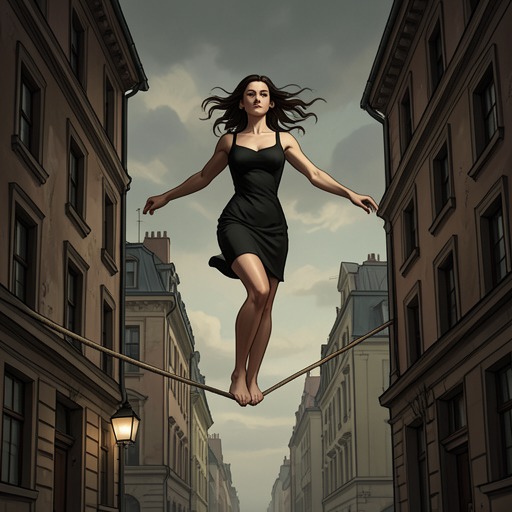
Blind Willow, Sleeping Woman“Just me and the wind” is Kirie’s description of the concentrated state she enters while performing on high-rise buildings. The phrase expresses both her sense of mutual understanding with the wind and the solitude that sets her apart from Junpei: after hearing her explain it, he realizes that no one can come between them and feels jealous of a force he cannot rival.
The wind as companion
Kirie tells Junpei that everything has reasons for acting as it does, including the wind and even a stone. People may fail to notice those reasons until something makes them pay attention. In her account, the wind envelops and rocks a person with purpose, while the stone, too, seems to know people thoroughly. Human beings can only take in these forces, go along with them, survive, and deepen.
The idea links Kirie’s words to Junpei’s developing story about the kidney-shaped stone. As she listens to him struggle to make the plot cohere, Kirie presses close and quietly shares her belief that the world’s actions have reasons, even when people do not recognize them. Junpei is falling asleep and cannot answer; her words reach him as impressions that blend into his consciousness. Over the next five days, he stays at his desk and writes the rest of the story, in which the stone continues to affect the doctor gradually but decisively.
Kirie’s performance
Kirie later explains the phrase in an interview about her profession as a high-rise performer. She assembles sponsors and gives performances on tall buildings; she has performed at a famous cathedral in Germany and wants to attempt higher buildings, though permission and safety are concerns. She also owns a window-cleaning company, but her interest is specifically in performing on high-rise structures, not working as a circus tightrope walker.
For Kirie, reaching a high place changes who she is. She says that she must change in order to survive there, and describes the moment as one in which she and the wind understand and accept each other. Once she steps onto the height and enters complete concentration, fear vanishes. The resulting state is a shared, enclosed stillness that she loves above all else; in it, she says, there is room for no one but herself and the wind.
Junpei’s jealousy and the phrase’s consequence
Junpei hears Kirie’s account in a taxi interview and cannot tell whether the interviewer understands her. After the interview, he stops the cab and walks the rest of the way. Looking up at buildings and passing clouds, he recognizes that no one can come between Kirie and the wind. His response is a violent rush of jealousy, although he cannot make sense of being jealous of the wind.
He waits several months for Kirie to contact him, hoping to see her and discuss many things, including the kidney-shaped stone. Her calls do not come, and his own calls cannot be completed. When summer arrives, he gives up hope. The relationship ends quietly, without discord or arguments, following the same calm pattern by which his relationships with other women have ended. He remains uncertain whether Kirie belongs among the three women who have truly mattered to him, and postpones deciding for another six months.
Narrative significance
The phrase connects Kirie’s account of physical concentration to Junpei’s emerging understanding that apparently separate forces may have their own reasons and effects. The wind is not merely scenery in her description: it is the presence with which she enters a life-sustaining mutual accord, and the bond that excludes everyone else. Junpei’s jealousy makes that exclusion legible as a change in their relationship, while the story leaves the wind’s purpose—and Kirie’s place in Junpei’s reckoning—unsettled.